
What Is Hyperthyroidism?
Roughly speaking, thyroxine (or T4) is a hormone that sets the rate at which many body processes run. That’s why an underactive thyroid (hypothyroidism) in a dog causes lethargy, poor hair growth and weight gain.
Thyroid problems in cats usually involve too much thyroxine, making many systems run too fast. The cause is typically benign enlargement of one or both thyroid glands. It occurs in up to 10% of old cats, making it their most common hormonal disease.
Untreated hyperthyroidism in cats leads to serious weight loss, hypertension and heart muscle disease and will significantly and negatively affect lifespan and quality of life.
What Are The Symptoms Of An Overactive Thyroid?
Hyperthyroidism is more common in moggies or cross breeds and less likely in Siamese, Himalayan, Burmese, Tonkinese, Abyssinian, and British shorthair breeds. Cats with thyroid disease can have:
- An increased appetite*
- Weight loss*
- Hyperactivity
- Increased drinking
- Poor coat condition*
- Diarrhoea or vomiting
- Hypertrophic cardiomyopathy
- Detached retinas & sudden blindness secondary to hypertension
- Kidney failure may be caused by or just found together with hyperthyroidism (both are very common in older cats)
- An occasional cat will have paradoxical lethargy and poor appetite instead
* Common.
The enlarged thyroid nodules usually cannot be seen, but can be felt by an experienced vet.
First we need to confirm our suspicions, which is very easily done with standard feline blood tests.
How To Treat Hyperthyroid Cats
With any treatment that normalises thyroid hormone levels, lifespan and quality of life return to normal. These can include all of the options below, although the dietary approach is less likely to do so on its own.
Thyroid Surgery
It’s quite possible to remove one of the thyroid glands. Thyroid removal is inexpensive and generally safe. Most cats then do not require treatment although 6 -monthly blood testing is needed to monitor them for recurrence.
Thyroidectomy is not our preferred option as there is a small risk of damaging the recurrent laryngeal nerve. Additionally, removing a solitary enlarged gland may only normalise thyroid levels for a few years. Despite this, in our experiences with thyroidectomy at Walkerville over the past 30 years, we have yet to see a cat develop recurrence of hyperthyroidism after unilateral thyroidectomy. We will not remove both thyroid glands due to the risk of damaging the parathyroid gland at the same time.
Anti Thyroid Medicines
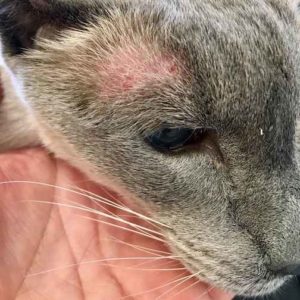
Most cats start here. Even if other options are advised, we need to use the reversible options first to see what effect normalising the thyroid hormone will have. If the kidneys can’t cope with the change we can easily stop or reduce the treatment.
There are several good tablet and liquid options allowing for once or twice daily treatment. Once we start medication we need to retest to make sure we are giving the right dose, then every 6 to 12 months.
Side effects from the use of carbimazole or methimazole are reasonably uncommon. We have seen vomiting, diarrhoea or facial wounds from scratching.
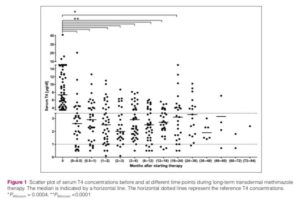
The use of anti thyroid medicines in a transdermal skin ointment has fallen out of favour as these cats do not enjoy the same level of control or lifespan as other cats. Pictured is a scatter plot of thyroid levels of cats on transdermal medication showing how many are above or below the ideal range. This is likely to adversely affect their lifespans.
Don’t worry if you’ve had trouble with tablets before. Thyroid medicines appear to be more easily tolerated and most owners manage to find a way. Many cats will just eat them in a treat, and those that don’t typically stop resisting the pill after a few weeks of treatment.
Radioactive Iodine Treatment
A single dose of I131 can normalise a cat’s thyroid hormone levels. This is especially attractive for cats that will be hard to medicate. Disadvantages are: cost, availability, the need to stay in a sealed environment for at least a week, and irreversibility if treatment unmasks kidney disease or leads to hypothyroidism. That is why this is never our first recommendation.
Iodine-restricted Diet
Another option for treatment is the use of a controlled diet very low in iodine, an essential element for thyroxine production. This gives us a valuable choice for treating selected cats or improving thyroid control in difficult cases. Owners need to be extremely diligent not to allow any other foods to be consumed, and results show not all cats achieve normal thyroid levels.
Generally, we reserve Hills y/d for cases where no other option is possible or in addition to other treatments to improve control.